By Brett Hetherington*
“Jesus said, ‘Let the little children come to me, and do not hinder them, for the kingdom of heaven belongs to such as these.’” – Matthew 19:14
Reading is taken for granted by many, a skill taught early in life that is needed for almost every task throughout a normal day. But what happens when middle school students have made it into fifth and sixth grades and have not learned how to read? This is where a group of volunteers from the Plain Township School District and Simpson United Methodist Church (Central Valley District) step in.
Church member Bonnie Ball used to work as an aide in the school district when she encountered the problem of students who could not read. When she met Victoria Newkirk the two set out to assist the students who were struggling to read.
“I met Victoria and we decided to have a program. Our church’s Resurrection team started going to the school once a month. We did reading, had a craft, a snack, did some math, a little bit of everything for 90 minutes,” she said. This was several years ago, and Ball and a couple of other volunteers still spend time tutoring in the school twice weekly. But their passion did not end at mere tutoring. They have built an entire summer camp experience aimed at helping kids learn how to read and gain confidence in themselves.
I had the opportunity to sit down with Newkirk, Ball and two other volunteers – Nancy Krantz and Rena Hamilton – for a wide-ranging, in-depth conversation about their ministry to the students in the school district.
Newkirk is the Behavioral Modification Coach for fifth and sixth grade in Plain Township schools. “Working in compliance I’ve been through all the buildings from pre-K up through 12th grade. I was devastated when I got to the high school building and I found out how many kids still couldn’t read,” she shared.
Throughout her time in many varied roles within the school district Newkirk discovered just how difficult it was to make people see how easy it is to overlook a student’s struggle to read. “One of the things I could not get the school systems to understand is that you make a lot of assumptions when you send things home. You assume they have a house. You assume they have electricity. You assume they know how to work a computer. You assume they have Wi-Fi. You assume their parents know how to read,” she said.
After several years of volunteering within the school district as tutors, Hamilton and Bell partnered with Newkirk and launched a one-day summer reading camp for 10 fifth and sixth graders. The day ran from 9:00 a.m. until 12 noon and included meals, leadership lessons based on scripture, varied reading activities, school success lessons such as filling out student planners, cooking, gross motor activities such as gym time and more. Each student received a Bible and at the completion of camp all students were given a backpack that they were able to “shop” to fill it with school supplies they would need to be successful in the coming year.
“We use Scripture like Daniel in the lion’s den to apply principles to everyday life. One kid has a mom who is on drugs, some have fathers who are not there – the lion’s den is different for each family and the only chance they have is Jesus,” said Newkirk.
She went on to share about one girl in camp who inspired them to include cooking in the curriculum last summer.
“One of the little girls in sixth grade, her spirit was so broken because she couldn’t read. We got her in camp. We explained to everybody that we want to make sure everybody is seen and everybody gets individual time. We found out through the camp one of the things she loves is cooking. So, we were showing her how reading can be for fun things like reading a recipe, it’s not just work, work, work,” Newkirk shared.
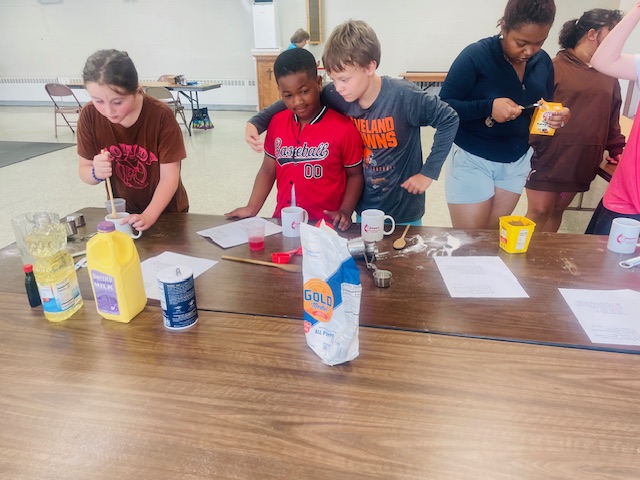
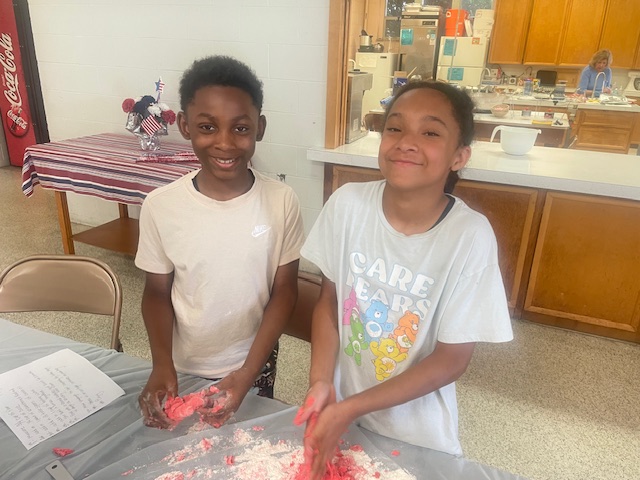
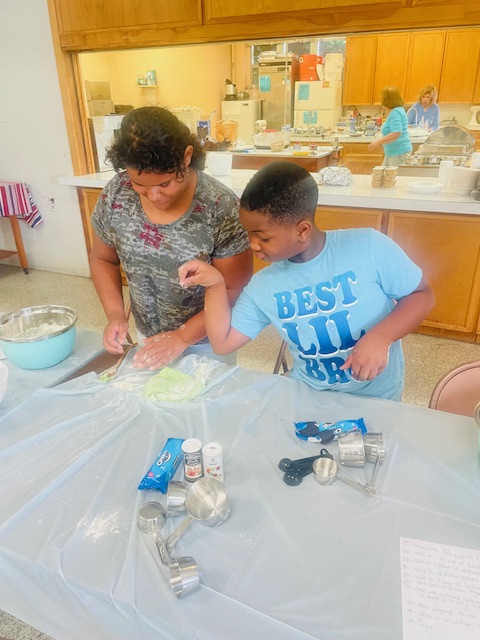
The team hopes to expand the summer 2026 reading camp to 20 students and will open the camp to those entering seventh and eighth grades to accommodate returning students. There is also a teacher with a reading endorsement who is working with the camp to develop training for all volunteers. Currently all camp volunteers are both safe sanctuaries trained and background checked by the school district.
Newkirk says the camp was a challenge for both tutors and students, with lessons emphasizing relearning phonemic awareness, fluency and sounds because a lot of technology has skipped over those things. But it was worth it.
“Three of the kids had D’s and F’s last year and right now they have all B’s and C’s,” she praised.
Camp also allowed students to build confidence in themselves and their abilities. In a world where students came into the camp broken and beaten down in their souls, the experience was restorative. As Newkirk shared, “If I feel good about myself, I believe I can do it. It makes me want to try.”
Hamilton highlighted the importance of congregations knowing how easy it is to help others.
“We can show older people that this doesn’t have to be done by someone in their 20’s and 30’s and 40’s. Many of us are retired. Maybe we don’t get around physically like we used to but that doesn’t mean you aren’t sharp mentally and can’t help someone with their reading. This can go UMC-wide. There’s too many kids who can’t read and there’s too many seniors who have nothing to do,” she said.
She went on to point out the importance of building a relationship with the students beyond just teaching them how to read.
“You think ‘what can three people do?’ For that one child that you help that’s enough because maybe that’s enough to help them make those changes in their life, especially as they leave that environment. To think that somebody who doesn’t look like them or act like them loves on them and cares what happens to them it can make a big difference,” Hamilton offered.
With looming cuts in education funding in the State of Ohio and shuffling priorities in local school district budgets it is easy for officials and community members to overlook something as simple as reading. But Newkirk, Bell, Hamilton and Krantz see this as an opportunity for the church to step up and stand in the ever-widening gap.
“This is the greatest time for the Church. We’re the lighthouse. They come to us for reading. While they are here for reading, we feed them. While they’re eating, we can give them clothes. We are the hands and feet of Jesus, not the government,” said Newkirk.
The system that these volunteers have put in place is one that they believe is replicable and can be instituted across all communities. Each church is in a community with a school, and every church has individuals able to volunteer time, or to offer something as simple as financial support for things like funding for background checks.
“If you want our counties to be strong, come on out and help us out a bit. This is the Church’s finest hour,” shared Newkirk.
The Conference Communications team would like to share other stories that highlight ways that each of us is answering the call to reach out to our communities in creative ways. Please e-mail your ministry story to EOC Executive Director of Communications Rick Wolcott at wolcott@eocumc.com.
* Brett Hetherington is the Communications specialist for the East Ohio Conference of The United Methodist Church.
 East Ohio News