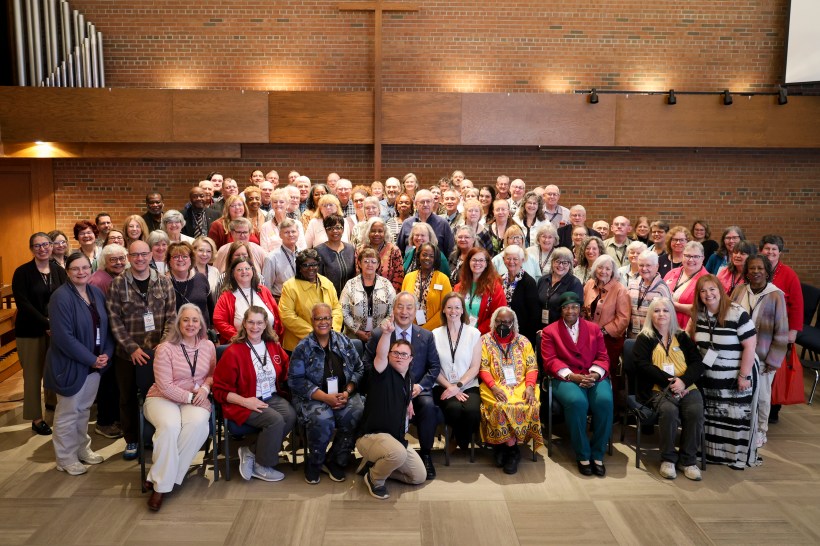
Laity from across Ohio participated in the Bishop’s Laity Leadership Convocation March 20-21 in Delaware. The convocation modeled the ways that the East and West Ohio Conferences are in ministry together as the Ohio Episcopal Area. Worship and learning sessions Friday and Saturday were hosted at William Street UMC, a West Ohio Conference church, and Friday evening’s Q&A session with Bishop Jung and prayer service were hosted at Asbury UMC, an East Ohio Conference church.
Opening Worship Service with Communion
The theme for the Bishop’s Laity Leadership Convocation was “Celebrating Abundant Grace”.
“God meets us exactly where we fall short. When life feels heavy, His powers shine the brightest. His grace is always enough, and His strength will never run out,” said East Ohio Conference Lay Leader Kimberly Green in her message during the opening worship service. “Where grace abounds, hope grows. Where grace abounds, faith is strengthened. Where grace abounds, lives are transformed. So go forward, walk boldly, and receive your abundant grace.”
A Historical Lens for Lay Leadership
Dr. Ashley Boggan, general secretary of the General Commission on Archives & History, was the weekend’s keynote speaker. Her three teaching sessions traced the history of Methodism: beginning as a lay movement, slowly changing to a clergy-centric denomination, and now looking to get back to its roots by focusing outside the church walls to make disciples.
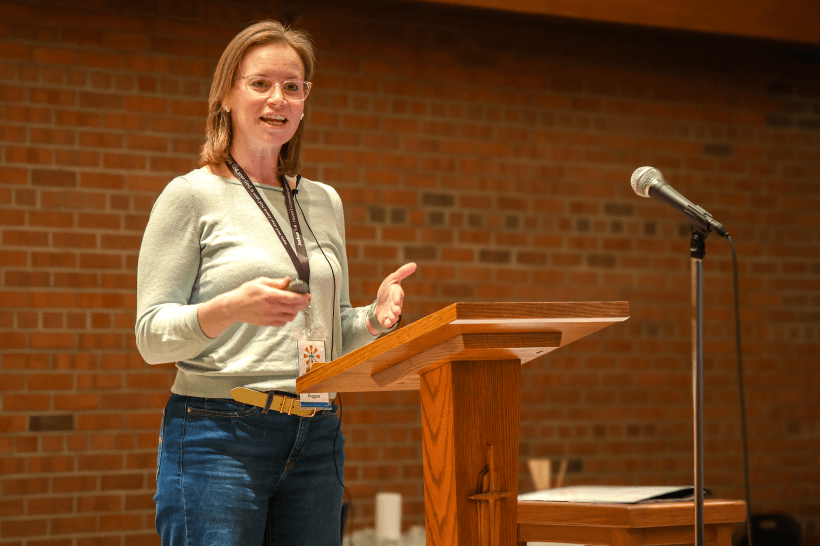
“The history of Methodism is, at its heart, a history of lay folk – women and men, rich and poor, young and old who heard God’s call and answered. They had no credentials of ordination, but they still had a heart strangely warmed and a call of God’s to follow,” Boggan said.
“If the circuit riders were the lightning of the Methodist Movement, the laity were the ground catching that fire and carrying it deep into the soil. They made holiness not a sermon but a practice,” she said. “By 1850 there were nearly one million Methodists in the United States. Most of them were converted, discipled, and sustained by lay leadership long before they even saw or heard an ordained minister. So, in early Methodism the mission did not wait for the clergy’s presence. The laity generated and sustained the mission.”
Bible Study
Bishop Hee-Soo Jung led a Bible study on Saturday titled “From Ochlos (crowd) to Ekklesia (a gathered people called into relationship)” grounded in the words of John 6:1-15, which tells of Jesus feeding 5,000 people with five loaves and two fish.
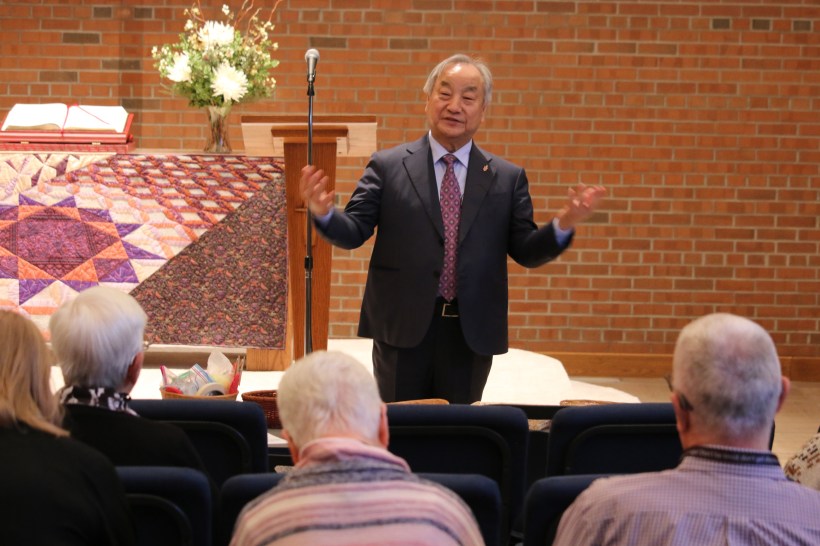
“The feeding of the five thousand is not only a miracle of bread; it’s a vision of the Church,” Bishop Jung shared. “The Church is the place where crowds become communities, strangers become neighbors, and small gifts become abundant grace. This vision speaks directly to the calling of the Church today. In a world of fragmentation, the Church is invited to become a living sign of God’s abundant community; a place where people discover that they belong to one another.”
The Past Can Shape the Future of The UMC
John Wesley believed that a person’s understanding of the Christian faith was framed by four components: Scripture, tradition, reason, and experience. Today those four components are commonly referred to as the “sides” of The Wesley Quadrilateral. In her closing teaching session of the Laity Convocation, Dr. Boggan expounded on a proposed new Wesleyan Practical Quadrilateral:
- Field Preaching – Taking Love Beyond the Walls
- Micro-Communities – Faith in Small Groups
- Social Engagement – Faith in Action
- Leadership Activation – Every Person Called
Boggan said, “A lot of what we are going through today in 2026 as the Church was going on in John Wesley’s Day. Back then, as today, it was believed that there was a major disconnect between the Church and the world, between the things said inside the walls and the actions of people outside. And John Wesley experiments with this method in order to connect those places and spaces. It worked back then. We don’t know if it will work today. We can at least experiment with the Wesleyan Practical Quad as a modern Methodist Movement that could work today and reinvigorate and put a little bit more movement back in The United Methodist Church.”
The Mission of Grace – Shaping the Future
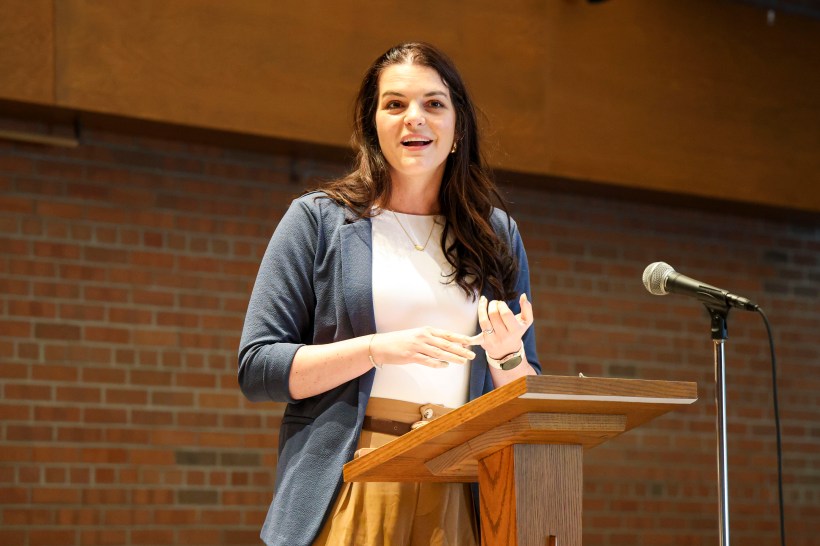
“When grace becomes our mission, the future changes,” said West Ohio Conference Co-Lay Leader Christina Albrecht in her message to participants in this final session of the Convocation.
“We all believe a future church is a church worth continuing to build and adapt. However, if we want a future marked by belonging, healing, and purpose, then grace cannot be an afterthought. It must be our mission. Not just something we talk about, but something we live – boldly, consistently, and together,” she said.
The session concluded with reporting from affinity groups, that met twice during Saturday’s sessions. Affinity groups and their facilitators were: The Historic Black Church (Dr. Martha Banks), Creation Care (Bob Downs), Youth and Young Adults (Anne Marie Carley), Storytelling (Sandra Coombs), Archives & History (Eddie Courtney), Rural Churches (Deb & Steve Gilson), The Social Principles (Jami Nathan), and Food Ministries (Diana Hall).
Closing Worship with Remembering Our Baptism
“Our baptism brought us into union with Christ, with one another, with the Church, through all circumstances and all situations and times and places,” said West Ohio Conference Co-Lay Leader Leslie Hall. “Beloved, John Wesley stressed the necessity of faith and repentance, along with the act of baptism. To truly represent God, we must be cleansed. In baptism, God offers us forgiveness of sin and we accept this gift.”
 East Ohio News