By Brett Hetherington*
“Those who cannot remember the past are condemned to repeat it.” The words from Spanish philosopher George Santayana have been repeated so frequently that you’d be hard pressed to find someone who hasn’t heard them before. The best way to remember our collective past is to re-tell its stories.
On September 21 the East Ohio Conference Anti-Racism task group hosted John Elford, author of Our Hearts Were Strangely Lukewarm: The American Methodist Church and the Struggle with White Supremacy. The book explores Methodist history from John Wesley through the present day, investigating the many ways the American Methodist Church became seriously entangled with white supremacy. The five-hour event for laity and clergy featured times of teaching, interaction, discussion, and fellowship.

Early in the agenda, Reverend Matthew Anderson, pastor of Bucyrus United Methodist Church (West Plains District) and a member of the task group, framed the day’s proceedings. “One of the pillars of our task force is to re-tell the stories of people that haven’t been told. We want to retell our stories, to find the history, what is happening in our areas, who was on the land before us, and to be able to do that well.”
Each member of the task group shared briefly, some recounting personal memories of encounters with racism, others sharing accounts of racism that had impacted their communities in East Ohio.
Re-telling the stories of the past is important, but it cannot be done alone.
“We’re not called to do this work in isolation, we all have to do this work in community. This is how we learn to build bridges. It is how we learn to be intentional,” said Pastor Tennille Power of Elyria First United Methodist Church (Northern Waters District).

Rev. David Whitt, a member of the task group with Anderson and Power and pastor of New London and Clarksfield United Methodist Churches (West Plains District), said, “We’re always building relationships, not only one-on-one but between churches, between communities.”
Elford shared much from his book during the two morning sessions he led.
“My book focuses on white methodists, and it took me a while to think that that is okay, because we caused the problem. It’s not brown supremacy or Black supremacy, its white supremacy,” he shared.
Elford has worked with the General Commission on Religion and Race to adapt his book into a teaching curriculum. “They told me that ‘the main reason that we picked your book to do the curriculum is because you’re a white person writing to your people about this stuff. And we don’t have this stuff going on in the church,’” he shared.

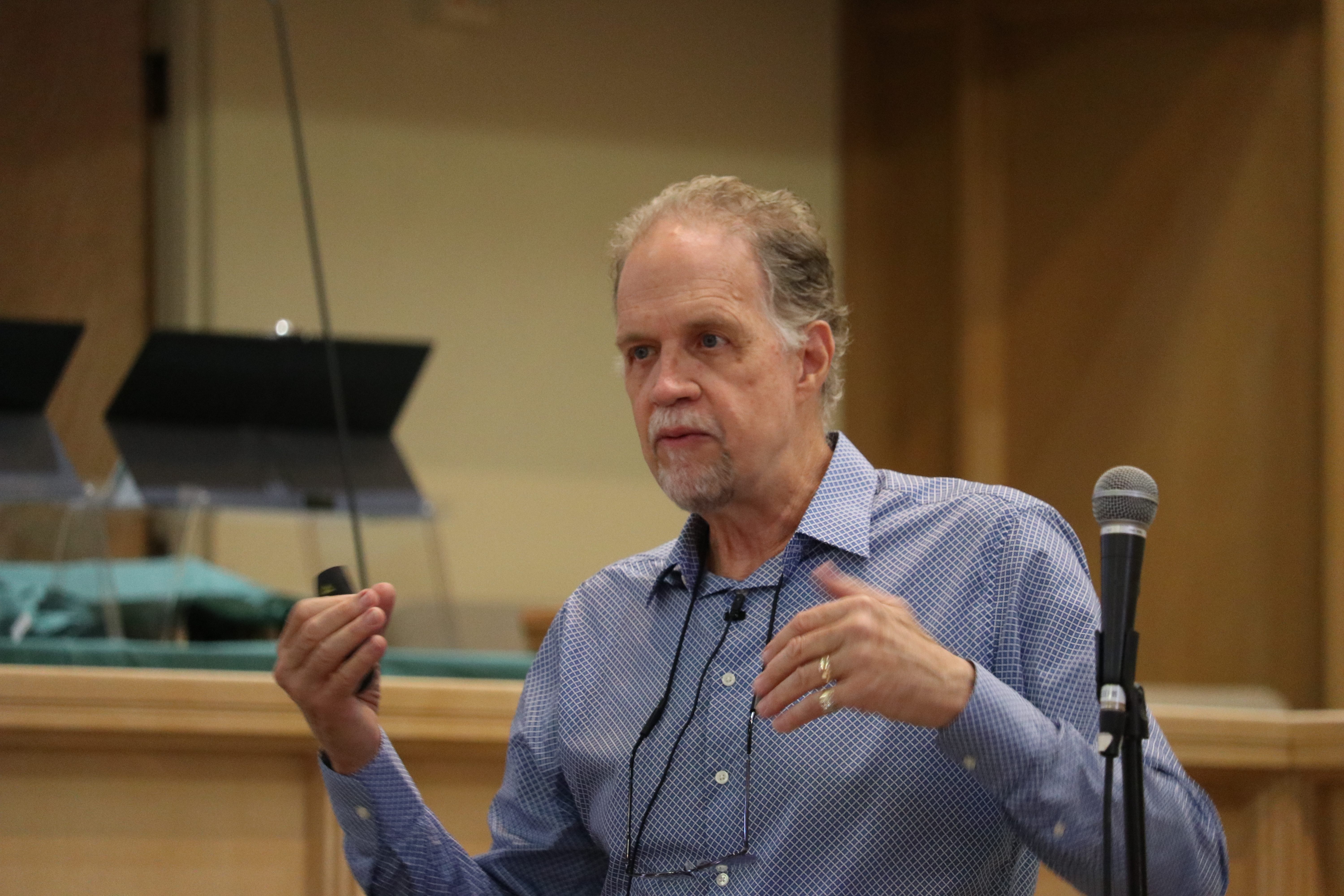
Throughout his teaching Elford was blunt with his facts but tempered that with grace as he looked for ways to move forward and work toward change. He shared that the story of America and the church’s struggle with racism is not as black and white as we might like it to be laid out for us. It is not one of inevitable progress, with heroes on one side and villains on the other. “There is progress, and we can see it, but looking at our history through the lens of progress is really misleading,” he shared.
That lens of progress can make us think that there is not much work left to be done.
“The good news is that we’re doing more in The United Methodist Church I think, than we have ever done to eradicate white supremacy. The not so good news is that since there have been decades when we did absolutely nothing that’s not saying a whole lot,” Elford stated. “There’s so much more work to do. It’s not at the General Conference, and it’s not in the hierarchy. It’s in the congregations.”
Re-telling was only one of the pillars upon which the anti-racism day of learning was built shared Rev. Jake Heskett, pastor of Sunbury United Methodist Church (West Plains District) and a member of the task group. “The cost of racism is incalculable but that doesn’t mean that we don’t do anything. One of our pillars is repair and reinvestment. The registration donation goes toward repair and reinvestment work,” he said.
The event left everyone involved with much to think about. Elford challenged attendees to do a lot of work within themselves and within their communities. Central Valley District Superintendent Rev. Cara Stultz Costello offered her hoped-for takeaway for participants.
“My hope is that we don’t take what we’ve experienced today and containerize it or spiritualize it. My hope is that like he (author Elford) has invited us to several times we continue to engage with the discomfort of it, maybe even dive further into discomfort and really begin to ask ourselves what can we do? It’s a core value of United Methodists. Jesus holds heart and hand together. This is going to hopefully warm up our hearts, so what are our hands going to do?”
The Conference Communications team would like to share other stories that highlight ways that each of us is answering the call to reach out to our communities in creative ways. Please e-mail your ministry story to EOC Executive Director of Communications Rick Wolcott at wolcott@eocumc.com.
* Brett Hetherington is the Communications specialist for the East Ohio Conference of The United Methodist Church.
 East Ohio News