By Brett Hetherington*
The targeted firebombing, looting and vandalism of the Hough Uprising that rocked the Cleveland neighborhood July 18-24, 1966, began after the white owners of the Seventy-Niners Café refused to serve a glass of water to a Black customer. Nearly six decades later the East Ohio Conference of The United Methodist Church played an important role in retelling this important story by helping to sponsor the installation of a historical marker on the Cleveland Civil Rights Trail of significant locations in the fight for equality in Cleveland.
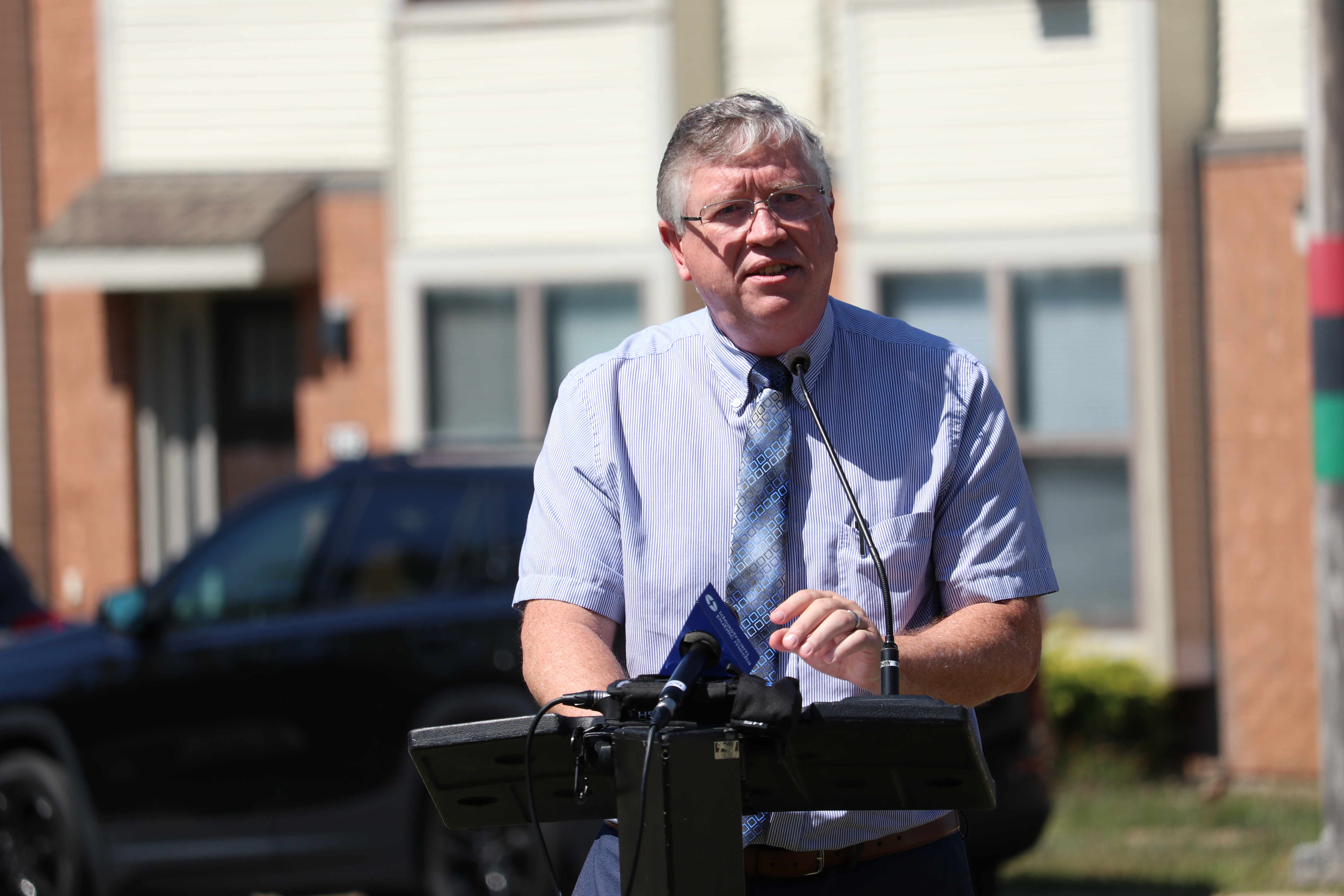
A crowd of city officials and residents gathered at the location where the Seventy-Niners Café once stood. Occasionally drivers would honk their horns in enthusiasm at the proceedings and pedestrians walking by would stop to listen to what was being shared from the microphone.
“The Civil Rights Trail is our way of tying place and people. There are many places in Cleveland that are historically significant in both Cleveland and the national conversation on activism around civil rights,” said Dione Alexander, chairperson of the Board for the Cleveland Restoration Society.

The Hough neighborhood was originally an exclusive community following incorporation into the City of Cleveland in 1873, and housed some of the city’s most prominent residents and private schools, densely populated with white working- and middle-class residents by mid-1900’s.
Highway development, urban renewal projects, restrictive banking and real estate practices, in combination with segregated public housing placement pushed displaced African Americans towards the Hough neighborhood. With an influx of Black migrants from the South during the Second Great Migration, Hough transitioned from a white to a Black community by 1960. At the time of the uprisings, Cleveland had become one of the nation’s most segregated cities with 90% of Cleveland’s Black community living in Black neighborhoods on the city’s east side.
“The Hough uprising of 1966, a four-day event that forever altered the political and social landscape of Cleveland and resonated throughout the United States. That incident was a match that ignited the kindling of decades of systemic racism, segregation and social injustice. But the resulting fire burned far beyond this isolated moment. It revealed the deep frustration of Black Americans who were denied basic human rights and dignity in a society where racism was not only pervasive but deeply embedded in its institutions,” shared Dr. Ronnie Dunn, executive director of the Diversity Institute at Cleveland State University.

The East Ohio Conference has been a committed partner with the efforts of bringing to light the stories of Cleveland’s past struggles with racism. The Conference previously was involved with the installation of another marker located at Cory United Methodist Church (Northern Waters District). Rev. Bruce Hitchcock, superintendent of the Northern Waters District, shared the importance of the church’s commitment to the cause.
“The church has a sacred duty to stand alongside those who have been marginalized and to be a force for that healing and for the reconciliation so badly needed. This dedication is particularly meaningful because it reflects our commitment to retelling the stories that matter. By sponsoring this marker, we affirm our role in lifting-up the voices of those who have fought for justice and ensuring that their legacy is preserved,” he said.
Shiloh Baptist Church was an influential church in the Hough community both prior to and after the uprising. Current pastor Rev. Dr. Lisa Maxine Goods was present at the marker dedication to share how the church had been involved in bringing peace to the neighborhood during that time.

“As the Civil Rights movement developed, we know that it was led by the Black church. It was led by Black preachers such as Dr. King, and in Cleveland there was no difference. The Civil Rights movement was led by preachers like my predecessor the Rev. Alfred M. Waller who, when the riots broke out led a contingent of clergy who not only worked within the community to negotiate peace in the community but took from the church’s resources and Shiloh rebuilt the home of a family that was burnt out in the riot and in that started a movement of Black churches that rebuilt homes, that invested in communities, invested in Hough to rebuild this community,” she said.
Trevor Rhodes of the Ohio Historical Society presented commendations from the Ohio History Connection prior to the unveiling of the new marker.


The afternoon was one of remembrance, sharing stories, personal reflections, and calls for change and progress. The gathered crowd was upbeat, enjoying the acapella stylings of Hue People which opened and closed the ceremony, setting a hopeful tone for the day.
Cleveland City Council Representative Stephanie Howse-Jones was bold in her musings on what the marker means to the city of Cleveland. She pointed out that the marker being unveiled was not just a reminder of past events, but a call to action to create a brighter future.
“This really is a physical monument that will give us a moment to understand our history, our place in our own story when we think about civil rights in our country,” she said. “And hopefully this will help to inspire generations of today and in the future. Because understand, civil rights didn’t just come. People had to fight for these things. And in 2024 I would be discouraged if people don’t understand that our civil rights are absolutely under attack. This isn’t just history; we have to do some history making in 2024 and beyond.”
Learn more about the Cleveland Civil Rights Trail.
The Conference Communications team would like to share other stories that highlight ways that each of us is answering the call to reach out to our communities in creative ways. Please e-mail your ministry story to EOC Executive Director of Communications Rick Wolcott at wolcott@eocumc.com.
* Brett Hetherington is the Communications specialist for the East Ohio Conference of The United Methodist Church.
 East Ohio News